
Research
“With more knowledge comes a deeper, more wonderful mystery, luring one on to penetrate deeper still.”
My research sits at the intersection of chemical physics and AMO physics, with a current focus on gas-surface
scattering dynamics. I am particularly interested in how energy is exchanged between gas-phase atoms and
metal surfaces — a problem that connects to surface chemistry, heterogeneous catalysis, and the fundamental
physics of non-adiabatic processes. Earlier in my career I worked on ultrafast electron dynamics using
time-dependent ab initio methods, and on mesoscopic transport problems including disorder-induced
localization and exciton migration. In the sections below I summarize my research projects chronologically,
starting with the most recent.
Publications
- Mocherla, Sai Vijay, and Raghunathan Ramakrishnan. "Variational augmentation of Gaussian continuum basis sets for calculating atomic higher harmonic generation spectra." arXiv preprint arXiv:2307.00732 (2023).
Current Research
Inelastic Scattering of Noble Gas Atoms from Au(111)
(PhD Thesis, 02/2024 – Present)
Advisor: Prof. Pranav R. Shirhatti, Surface Dynamics Group, TIFR Hyderabad
Understanding how energy is transferred between gas-phase atoms and solid surfaces is a fundamental question in surface dynamics. My thesis focuses on the inelastic scattering of noble gas atoms (Kr, Ar, Xe) from the Au(111) surface using molecular beam techniques. By measuring the angular and energy distributions of scattered atoms we can extract detailed information about the energy transfer mechanisms — including phonon excitation and trapping-desorption channels. These experiments help build a quantitative picture of gas-surface energy exchange that is relevant to understanding surface chemistry and heterogeneous catalysis. The project also involves development of fast high-voltage switches for charge-particle extraction in coincidence experiments.
Machine-Learning Interatomic Potentials for C-Atom Scattering on Au(111)
(Visiting Student, 01/2025 – 03/2025)
Advisor: Prof. Alexander Kandratsenka, Max Planck Institute of Multidisciplinary Sciences, Göttingen
During a three-month visit to the Kandratsenka group at the Max Planck Institute in Göttingen, I performed plane-wave DFT calculations to generate training data for machine-learning based interatomic potentials (MLIP). These potentials are used to simulate the scattering dynamics of carbon atoms on the Au(111) surface — a system where non-adiabatic energy dissipation via electronic friction plays a significant role. I also contributed to the development of electronic friction-based models for simulating gas-surface scattering more broadly.
[ Report ]
Previous Research Projects
Optimized Gaussian Basis Sets for Atomic High-Harmonic Generation Spectra
(Junior Research Fellow, 09/2021 – 05/2023)
Advisor: Prof. Raghunathan Ramakrishnan,
MolDis Group, TIFR Hyderabad
High-harmonic generation (HHG) spectra are a powerful probe of ultrafast electron dynamics in atoms and molecules. However, standard Gaussian basis sets used in quantum chemistry are not well-suited for describing the highly oscillatory continuum-like states involved in strong-field processes. In this project I developed a variational method to augment existing Gaussian basis sets with continuum functions specifically optimized for reproducing atomic HHG spectra computed with the time-dependent configuration interaction (TDCI) approach. This makes accurate HHG calculations tractable within a localized-basis framework, enabling the study of electron-correlation effects on strong-field spectra.
[ arXiv:2307.00732 ]
References:
- Krause, J. L., Schafer, K. J., and Kulander, K. C. "High-order harmonic generation from atoms and ions in the high intensity regime." Phys. Rev. Lett. 68.24 (1992): 3535.
- Lopata, K., and Neuhauser, D. "Nonequilibrium core-electron dynamics in time-dependent configuration interaction." J. Chem. Phys. 139.1 (2013): 014102.
Earlier Projects
Effect of a pure dephasing bath on Localisation in Open-Quantum Systems.
(Final project for CHM-452 Quantum Dynamics)
Advisor: Prof.Ignacio Franco, University of Rochester
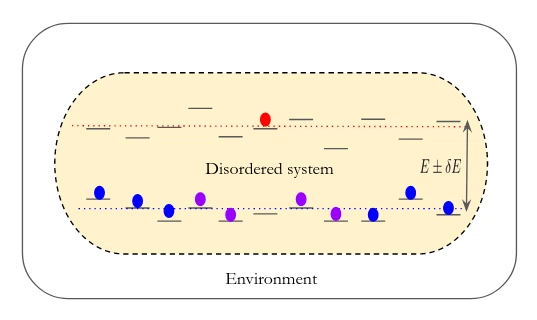
The physics of localization-thermalization transitions is currently under active investigation. It holds the key to applications like noise-tolerant quantum memories and, more fundamentally, to our understanding of non-equilibrium statistical mechanics. In my project, I derived a Lindbladian master equation for a 1-dimensional tight-binding model interacting with a pure dephasing bath to study localization in open quantum systems. I basically solved the Liouville-von Neumann equation and evaluated disorder averaged populations at each site in the long time limit. Through these back-of-the-envelope style quick numerical calculations, we found that localization could be altered as a function of system-bath interactions.
[ Code ]
References:
- Lüschen, Henrik P., et al. "Signatures of many-body localization in a controlled open quantum system."
Phys.Rev.X 7.1 (2017): 011034. {arXiv:1610.01613} - Yusipov, I., et al. "Localization in open quantum systems." Phys.Rev.Letters 118.7 (2017): 070402. {arXiv:1612.01503}
- Vakulchyk, I., et al. "Signatures of many-body localization in steady states of open quantum systems."
Phys.Rev B 98.2 (2018): 020202. {arXiv:1709.08882}
Discrete-space Random walks
(Summer Research Internship)
Advisor: Prof.Upendra Harbola, Indian Institute of Science(IISc), Bangalore.
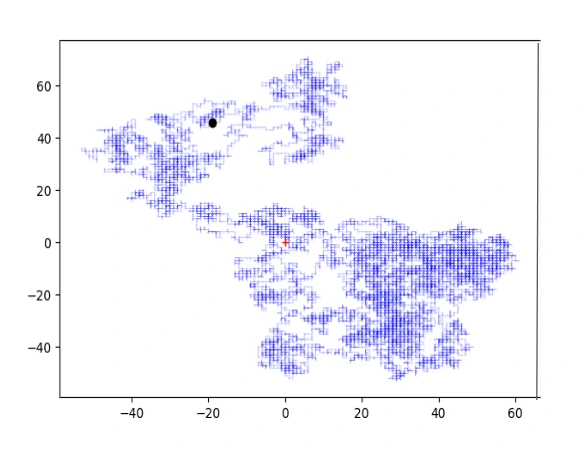
I briefly explored the lattice random walks to model the transport process in mesoscopic systems. During the summer, I spent time working my way through the textbooks by Abraham Nitzan and Frank Spitzer to understand classical random walks. I did some rudimentary calculations to explore their link to exciton transport models.
[ Code ]
References:
- Nitzan, Abraham. Chemical dynamics in condensed phases: relaxation, transfer and reactions in condensed molecular systems. Oxford university press, 2006.
- Spitzer, Frank. Principles of random walk. Vol. 34. Springer Science & Business Media, 2013.
Effect of Torsional disorder on Exction transport in conjugated polymers
(Masters thesis research)
Sri Sathya Sai Institute of Higher Learning
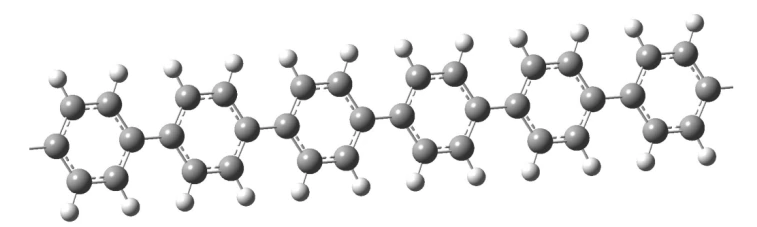
a conjugated polymer.
In organic semiconductors, disorder-induced localization of exciton presents a challenge to the development of sustainable organic photovoltaics. In my project, I developed a model of an exciton coupled to rotational degrees of freedom of each sub-unit(chromophore) in a conjugated polymer to study the effects of torsional disorder on exciton migration rates. As a first step, I studied the diffusion of excitons in ordered chains and derived an analytic expression for time-averaged transition probability. Further, I used exact diagonalization methods to numerically calculate disorder averaged quantities for static and dynamic torsional disorder cases. In general, I found that the exciton migration rates in the disordered molecules decreased inversely with the increasing length of the polymer.
References:
- Barford, William, and Oliver Robert Tozer. "Theory of exciton transfer and diffusion in conjugated polymers."
The Journal of chemical physics 141.16 (2014): 164103. - Barford, W., and J. R. Mannouch. "Torsionally induced exciton localization and decoherence in π-conjugated polymers."
The Journal of Chemical Physics 149.21 (2018): 214107-214107.
Dynamics of Surface Plasmon Polaritons in Plasmonic Quasi-Crystals
(Summer Internship Project)
Advisor: Prof.Venu Gopal Achanta, Tata Institute of Fundamental Research(TIFR), Mumbai
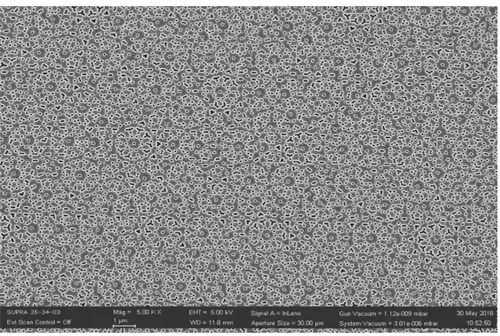
The optical transmission through thin metal films is known to be poor but, the observation of enhanced optical transmission through sub-wavelength(nano-meter sized) holes due to the coupling with surface modes has attracted a lot of interest. This is popularly known as 'Extra-ordinary Optical Transmission.' The optical properties of such air-hole arrays on a metal-dielectric interface have been studied in many different configurations and arrangements. One such system is the Plasmonic quasi-crystal that has a unique property of tunable broadband optical transmission.
We attempted to understand the underlying mechanism of interaction between light and surface plasmon modes during my internship. My work involved using electron beam lithography, reactive-ion etching, and other cleanroom techniques to design and fabricate quasi-periodic patterns of these holes on gold thin films. I also used different experimental techniques in tandem, like pump-probe spectroscopy, to study the dynamics of surface-plasmon polaritons in these nanophotonic structures. The science we discovered through these experiments could help develop novel photonic devices for applications ranging from solar-energy conversion to optical communications.
[ Report ]
References:
- Ebbesen, Thomas W., et al. "Extraordinary optical transmission through sub-wavelength hole arrays."
Nature 391.6668 (1998): 667-669. - Kasture, Sachin, et al. "Plasmonic quasicrystals with broadband transmission enhancement."
Scientific reports 4 (2014): 5257. - Achanta, Venu Gopal. "Plasmonic quasicrystals." Progress in Quantum Electronics 39 (2015): 1-23.